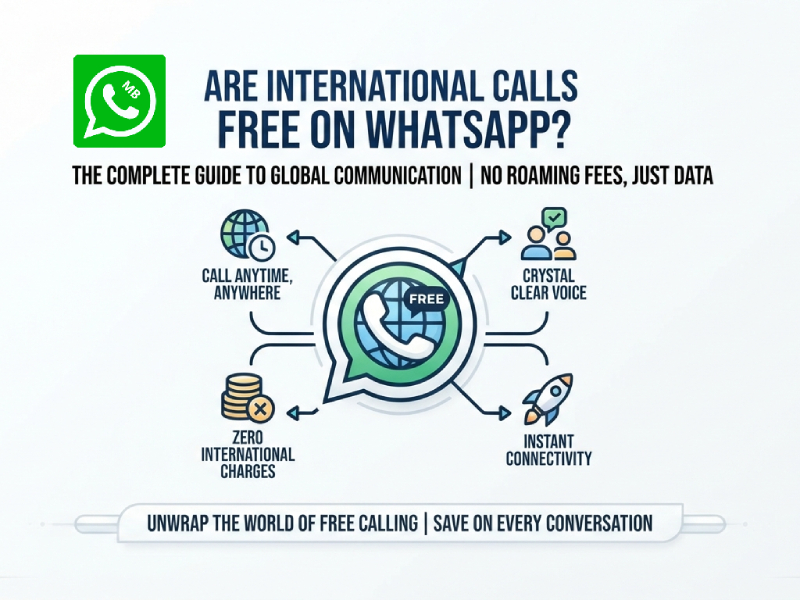
WhatsApp is widely used for cross-border instant messaging and calls. One of the most common questions about this app is whether WhatsApp’s international calls are free. The answer is not a simple “yes” or “no”, because it depends on how you define usage costs and what resources are involved. In general, WhatsApp does not charge extra fees for voice or video calls between countries, but it still relies on an active internet connection, meaning mobile data or Wi-Fi usage can affect your overall cost. This is why the idea of international calls free is often understood as “no call charges” rather than completely zero-cost communication.
In the last article, we talked about the ways to set up dynamic island-style notifications for MB WhatsApp calls. This article will explain how WhatsApp international calls work, potential indirect costs, and other essential information about the calling system that users should know.
Understanding WhatsApp Calling
WhatsApp calls are based on internet communication rather than traditional telephone systems. Instead of using mobile voice networks, it converts voice into digital data and transmits it over the internet. This approach changes how calls are initiated, connections are established, and communication occurs between users, similar to how an international phone call app routes voice traffic through data networks instead of conventional carrier lines.
When a call begins, the app establishes a direct connection between the two devices via WhatsApp servers. The microphone will capture your voice, convert it into small data packets, and transmit it in real time. At the receiving end, these data packets are reassembled and converted back into sound. The entire process continues, resulting in a smooth and natural dialogue with extremely low latency.
WhatsApp uses the same core system to support both voice and video calls. Voice calls focus solely on audio transmission, making them more lightweight and stable. Video calls enhance the visual experience by transmitting live camera footage. Both call methods follow the principle of real-time data transmission, but video calls require higher bandwidth because they need to transmit additional image data.
In summary, WhatsApp Calls aims to simplify communication by replacing traditional call infrastructure with internet-based transmission.
How International Calls Work on WhatsApp
WhatsApp’s international calls are based on internet communication, not the traditional telephone network. Users hardly notice the process, but it follows a clear technical workflow. Understanding this helps explain why international calls can be made without a separate dialing system or international routing fees.
1. Internet-Based Connection
WhatsApp calls do not use standard telephone lines, but rely on the internet.
- The app connects both users through data networks
- Voice is converted into digital information
- This information is sent through the internet in real time
Because of this structure, there is no difference in how local calls and international calls operate.
2. Digital Signal Conversion
When a call starts, the user’s voice is not transmitted as sound.
- The microphone captures the voice
- WhatsApp converts it into small data packets
- These packets represent segments of audio
At the receiving end, the processing is the opposite. The data is reassembled and played back as sound through a speaker.
3. Data Packet Transmission
The key mechanism behind WhatsApp calls is packet-based transmission.
- Audio is split into small packets
- Each packet travels independently through the network
- Packets may take different routes to reach the destination
- The system reorders them upon arrival
This method allows efficient and fast communication, even across long distances.
4. Role of Servers and Routing
WhatsApp uses servers to help manage call connections.
- Servers help establish the connection between users
- They assist in finding the most efficient route
- They support synchronization between devices
Once the connection is established, most calls are conducted directly between the devices as much as possible to reduce latency.
5. Real-Time Synchronization
International calls require real-time transmission to feel natural.
- Audio data is sent continuously in both directions
- Small delays may occur due to network conditions
- The system adjusts speed and quality dynamically
This ensures smooth conversations even if users are in different countries.
6. Network Quality and Adaptation
The system automatically adjusts based on the internet strength.
- Strong connections allow higher audio clarity
- Weak connections reduce the ability to maintain stability
- Temporary interruptions may cause short delays in sound
These adjustments happen automatically without user control.
Data Usage During Calls
Although WhatsApp does not charge for calls, data usage can still have an impact.
Voice calls typically consume less data than video calls. Video calls require more bandwidth because audio and video information needs to be continuously transmitted.
The actual amount of data consumed depends on the call duration and network connection quality, and this is also true when using a free int call feature. The longer the call lasts, the more data is consumed. Poor network conditions can also lead to duplicate data packet transmissions, thereby increasing data consumption.
However, WhatsApp does not limit call duration due to international borders.
Difference Between WhatsApp Calls and Traditional International Calls
| Aspect | WhatsApp Calls | Traditional International Calls |
| Network used | Internet connection (Wi-Fi or mobile data) | Telecommunication voice network |
| Charging method | No per-call charge from the app | Charged per minute or via international call plans |
| Cost structure | Depends on internet data usage | Depends on distance, carrier, and duration |
| Country limitation | No difference between domestic and international calls | Higher cost for cross-country communication |
| Setup required | Only the internet and a WhatsApp account | May require international calling activation or packages |
| Call routing | Digital data packets over the internet servers | Routed through international telephone networks |
| Call quality factors | Internet speed and stability | Network routing and carrier infrastructure |
| Video call support | Available within the same system | Usually requires separate services or higher fees |
| Group calls | Supported internationally without extra charge | Limited or more expensive, depending on the carrier |
| Accessibility | Works anywhere with internet access | Depends on carrier coverage and roaming agreements |
Group International Calls
WhatsApp supports cross-border group calls, allowing multiple people to join a voice or video conversation simultaneously. Participants can be in different locations, but the call is conducted through a single connection shared over the internet.
In international group calls, all participants connect via WhatsApp’s real-time data system. Each device continuously sends and receives audio or video data, keeping conversations synchronized even when users are geographically far apart. The location of each participant does not affect the establishment or routing of the call.
Group calls are commonly used for family communication, remote work discussions, and small group conversations involving people from different countries/regions. The experience is similar to a one-on-one call, but it combines multiple audio streams into a single session. The system manages these audio streams to ensure that each participant can hear and respond in real time.
Requirements for Making International Calls on WhatsApp
To make international calls using WhatsApp, some basic requirements need to be met. These requirements are not complicated, but each one is crucial to the connection and stability of the call.
You need a valid WhatsApp account. The account is associated with a mobile phone number used for authentication. Once the account is activated, international calling functionality can be used without any additional setup.
You need a network connection, especially when using WhatsApp for free international telephone calls. WhatsApp calls do not use traditional phone lines, so Wi-Fi or mobile data must be used. Call quality largely depends on the stability of the network connection. A more stable and smoother network connection usually results in clearer audio and fewer interruptions.
The recipient must also use WhatsApp. Only users who have registered for WhatsApp can make calls. The contact must be saved on your phone and be available in WhatsApp for the call option to appear.
In addition, your device must support the latest version of WhatsApp. Regular updates help maintain call functionality compatibility and improve overall performance. Older versions of the application may limit certain features or reduce call quality.
Conclusion
International calls via WhatsApp are completely free within the app. Calls are free of charge, regardless of distance, country/region, or call duration. All calls made on the platform are treated equally.
However, this service relies on a network connection, and depending on the network used, it may generate data traffic.
This system replaces the traditional international calling model with an internet-based architecture, making cross-border communication more convenient and unified.