If you’ve ever stopped to ask is WhatsApp social media, you’re far from alone. As one of the most widely used communication tools on the planet, WhatsApp has evolved far beyond simple text chats. It adds status updates, group communities, and media sharing that blur the line between private messaging and social interaction. To answer the question clearly, we first need to break down what is WhatsApp at its core, examine its key features, and weigh them against the standard definition of a social platform.
This guide unpacks the ongoing debate around is WhatsApp a social media platform, explains what is WhatsApp used for today, and gives you a definitive answer about where the app falls in the digital landscape.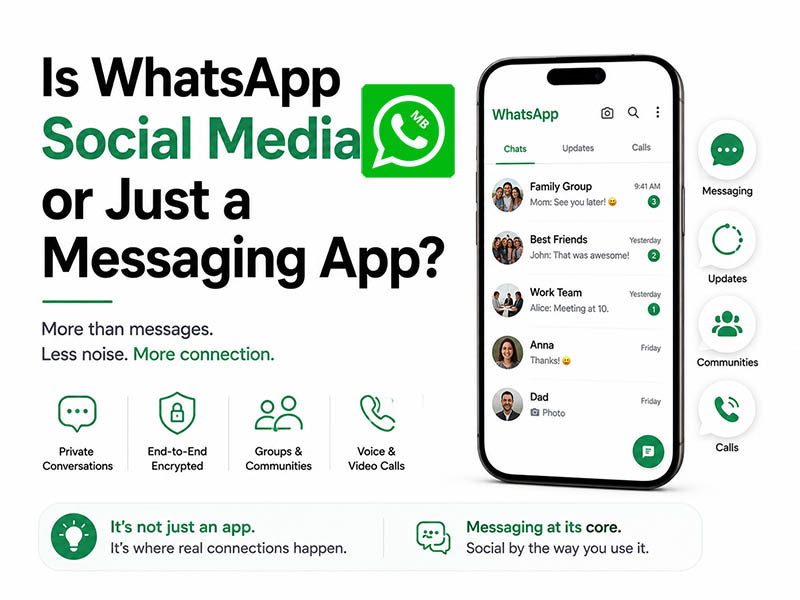
What Defines a True Social Media Platform
Before we can settle whether WhatsApp qualifies, we need to establish what makes a platform “social media” in the standard industry sense. True social media platforms share these core, defining traits:
- Public user profiles visible to anyone on the platform, even complete strangers
- Publicly shareable content that can be discovered, liked, and reshared by users outside your direct contact list
- Algorithm-driven content feeds that surface posts from accounts you do not follow
- Built-in tools for growing a public audience and reaching new people
- Viral content potential, where posts can spread widely beyond a user’s immediate personal circle
Platforms like Instagram, Facebook, X (formerly Twitter), and TikTok fit this definition perfectly: they are built around public content discovery and broad, open social reach.
Why People Ask Is WhatsApp a Social Media Platform
It’s easy to see why the debate exists. Over the years, WhatsApp has added features that look and feel very similar to social media, leading many users to question its classification. Here are the biggest reasons people wonder is WhatsApp social media:
- WhatsApp Status Updates
The 24-hour disappearing photo and video status feature works almost identically to Instagram Stories or Facebook Stories. Users share daily moments, life updates, and casual content with their full contact list. This is a classic social media behavior that feels far more interactive than basic text messaging.
- Large Group Communities
WhatsApp supports group chats with hundreds or even thousands of members. These groups function like small, closed social communities, where members share ideas, media, and updates around shared interests, work projects, or social circles. For many users, these groups are a core part of what is WhatsApp used for beyond one-on-one chats.
- Rich Media Sharing
From photos and videos to voice notes and documents, WhatsApp is built for sharing personal content; just like traditional social platforms. Many people use the app to keep up with friends’ and family’s daily lives through shared media, mirroring the use case of more traditional social networks.
- Broadcast Lists & One-to-Many Communication
Broadcast lists let users send updates to multiple contacts at once, similar to posting an update for a follower list. This one-to-many publishing behavior is another feature that overlaps with social media functionality, especially for small creators and business users.
Why WhatsApp Is Primarily a Messaging App
Despite these social features, is WhatsApp a social media platform? The answer is no; at least not by the standard industry definition. The app’s core design and fundamental purpose set it firmly in the messaging app category, for these key reasons:
- Privacy is the default setting
Every WhatsApp chat, whether one-on-one or in groups, is end-to-end encrypted by default. Content is never public, and it can only be seen by direct participants in the conversation. There is no way for strangers to find or view your messages, statuses, or profile. This is the opposite of how social media platforms work, where public visibility is the default.
- No public profiles or content discovery
There is no public search function, no explore page, and no way to find and follow users you do not already know. Your WhatsApp network is limited exclusively to people whose phone numbers you have saved. There is no algorithm feeding you content from strangers, and no way to build a public, searchable audience. Yet this is a basic feature of all major social media platforms.
- Its core purpose is private communication
At its heart, what is WhatsApp built for? Direct, private conversation. All social features are add-ons to the core messaging function, not the main product. Social media platforms are built around content publishing and public engagement; WhatsApp is built around private, personal communication between people who already know each other.
- No viral or public reach potential
Content on WhatsApp cannot go viral in the social media sense. Posts, statuses, and media only spread between people who already have each other’s contact information. There is no shareable public link for status updates, and no mechanism for content to reach users outside your saved contact list.
The Verdict: Where WhatsApp Actually Fits
So, is WhatsApp social media? The short answer: no, it is not a social media platform in the traditional sense. It is first and foremost an instant messaging app; but it is a messaging app with strong, well-integrated social features.
A more accurate label is a social messaging app. It prioritizes private, direct communication like a standard messaging tool, but includes light social functionality that lets users share updates and interact in larger groups. It sits somewhere between basic SMS and full social media, but it never crosses fully into social media territory.
To put it simply: if your main goal is to publish content for a public audience, grow a following, or discover new content from strangers, WhatsApp is not a social media tool. If your goal is to chat privately with people you know and share a few everyday stories along the way, then WhatsApp is the perfect app for that..
What This Classification Means for Users and Businesses
This distinction matters for how you approach the app, both personally and professionally:
- For personal users: You can treat WhatsApp as a private, secure space for conversations, without worrying about public visibility, algorithmic feeds, or unwanted attention from strangers.
- For businesses and marketers: WhatsApp is a private, one-to-one customer communication tool, not a public social media marketing channel. It works best for customer support, order updates, and personalized outreach — not for viral content or public audience growth.
For users who want even more control over their private WhatsApp experience, modified versions like MB WhatsApp build on this core messaging foundation with enhanced, user-focused features. If you want to explore all the unique tools MB WhatsApp brings to private messaging, check out our dedicated roundup: Top 6 Uses of MB WhatsApp You Probably Didn‘t Know About.
Final Thoughts
At the end of the day, the debate around is WhatsApp a social media platform comes down to how broadly you define “social media.” According to strict industry standards, WhatsApp is primarily an instant messaging application. Its social features are merely supplementary, aiming to enhance rather than replace its core communication functions.
Understanding what is WhatsApp and what is WhatsApp used for helps you use the app more intentionally: as a secure, private tool for staying connected to people you know, rather than a public platform for sharing content with the world.